
What is Net Abundance?
About Joshua

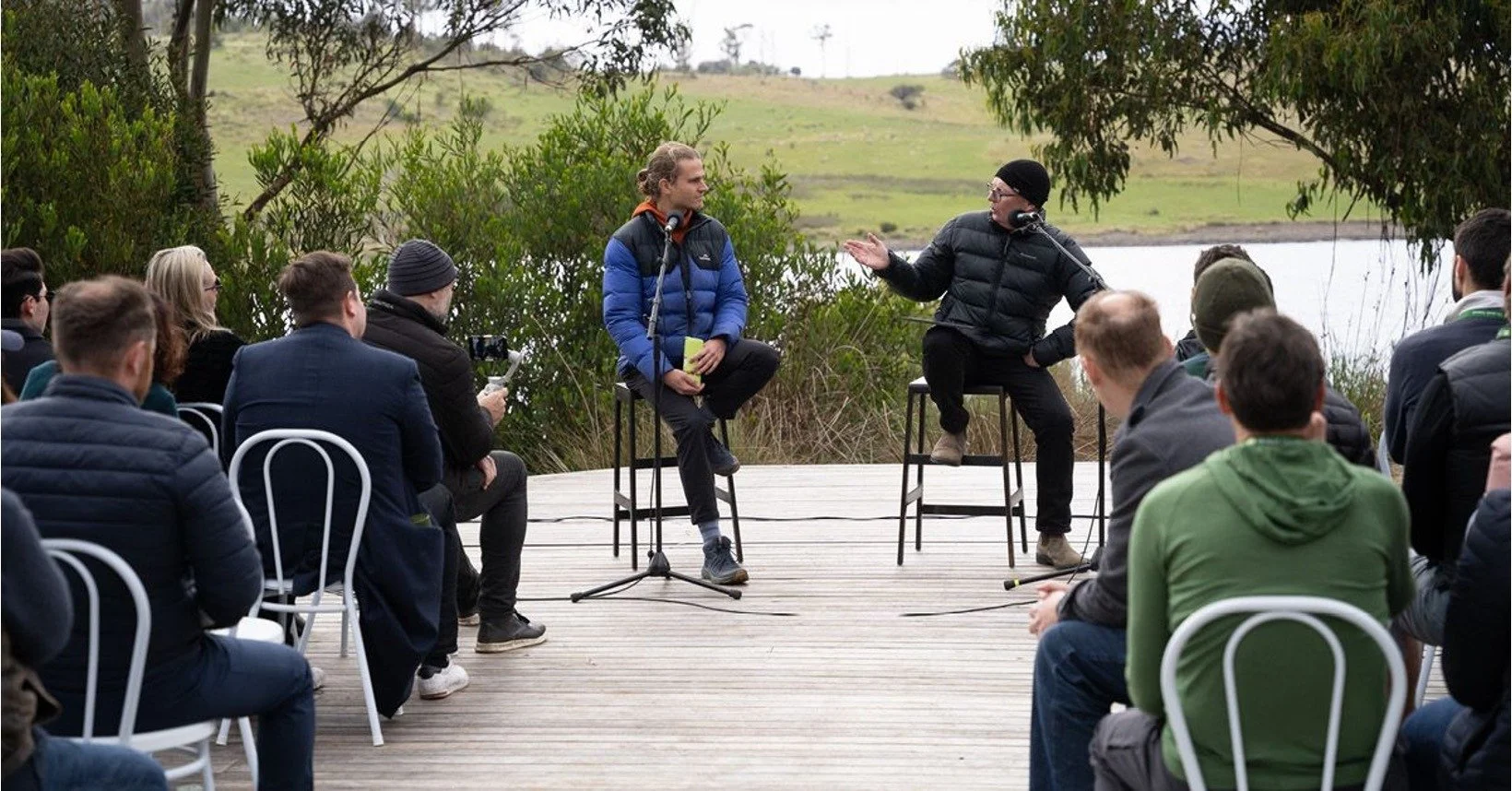
Joshua Castle is a PhD candidate at the Australian National University's School of Cybernetics, where his research develops a system for governing societies in the age of exponential AI. The research asks what structural conditions keep human freedom and imagination open alongside the technologies we build. His work sits at the intersection of political philosophy, systems engineering, cognitive science, ecology, and cybernetics systems theory. An XPRIZE Milestone Award-winning innovator, Joshua has worked across multiple startups on challenges from knowledge management to carbon removal, as well as research used for Australian policy.
Joshua energetically follows his vast curiosity through reading and traveling widely. He also explores ideas through writing science-fiction. A place he can goes to see beyond ordinary boundaries.

Research
Net abundance describes a dynamic that has always existed across civilisation and the biosphere, from technological development to ecosystems, cognition, and culture, but has never been conceptualised as a single design criterion applicable across scales.
Examples:
Agriculture that restores soil health preserves versus agriculture that destroys it and consumes the very system it depends on.
Long-term supplier relationships generate compounding industrial capability and tacit knowledge, while short-term outsourcing fragments and dissipates it.
A building engineered to last 500 years versus 50 years.
A child learning mathematics builds cognitive depth, while the same hours spent in passive media consumption erodes it.
Interoperable data standards allow knowledge to compound across disciplines and institutions, while locked platform ecosystems capture and terminate it.
AI used to augment heterogeneous human reasoning expands the generative range of cognition, while AI that homogenises human thinking converges culture toward uniform outputs and produces measurable psychic entropy at civilisational scale.
Indications of this dynamic appear across thermodynamics (Prigogine, 1978), complexity science (Kauffman, 2019), and positive psychology (Csikszentmihalyi, 1990, 1993). The Economic Complexity Index (Hidalgo & Hausmann, 2009) demonstrates that nations generating more heterogeneous, diversified economic output consistently outperform those that optimise narrow comparative advantage, which points to generative complexity as a driver of long-run prosperity rather than a byproduct of it.
It is hypothesised that this dynamic shows recurring features and, when they are present, net abundance can grow. One key feature is heterogeneity. The Principle of Maximum Heterogeneity (Artis, Akarca & Achterberg, 2026) shows that in computational and biological systems, heterogeneous architectures achieve performance, resilience, and efficiency simultaneously to a degree unreachable by homogeneous optimisation. In the terms of this thesis, this heterogeneity is not just variety for its own sake. It is structured diversity that increases the depth of assembly and the range of possible futures the system can realise. That increase in generative capacity is what I define as net abundance.
What has been missing across all of these literatures is a way to conceptualise this dynamic from a civilisational decision-making and governance standpoint. It is hoped that if we understand this we can govern civilisation for the better, particulary as society radically changes with the implementation of AI at scale.
This leads to three research questions:
What is net abundance in the age of AI?
What does increasing net abundance look like on a civilisational level in the age of AI?
How can net abundance be envisioned and co-created?


The Podcast
Speaking to leading visioneers around the world about how they are working to imagine and create a better future. Exploring different conceptions of net abundance across domains and cultures to uncover key patterns.
For innovators, thinkers, and creatives who are concerned about the future and want a dose of hope.
Interviews in progress. First episode out October 2026
Subscribe to research and podcast updates here (infrequent)
Inquiry
Please reach out to discuss research, fiction, or philosophy